The rapid evolution of cyber threats and the increasing complexity of digital ecosystems have underscored the need for advanced cybersecurity measures. Intelligent agents will emerge as a promising approach for addressing these challenges, leveraging AI and machine learning techniques to detect and mitigate cyber threats in real-time.
However, the design and deployment of effective agent-based solutions require a structured approach to ensure scalability, interoperability, and adaptability across diverse environments.
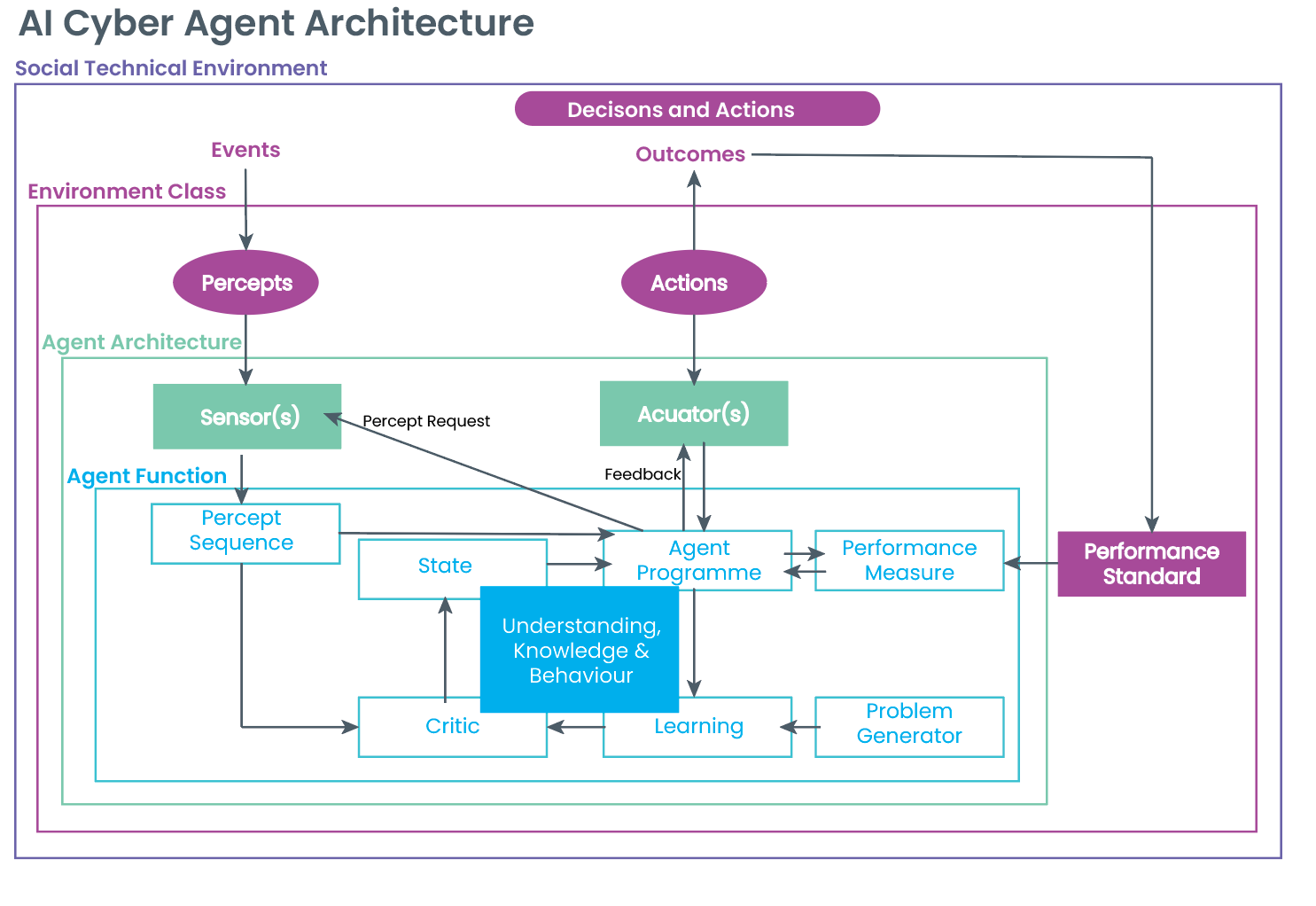
This article provides a reference architecture, tailored specifically for AI cybersecurity agents, providing a framework to guide: testing, design, implementation, and evaluation.
Architectural Reference Layers
This article introduces a four-layer reference architecture:
- Social-technological environmental layer
- Environmental layer
- Agent architecture
- Agent function
Social-Technological Environment
The social-technical environment encompasses the broader context in which AI cybersecurity agents operate. This includes the organisational culture, regulatory requirements, user behaviours, and technological infrastructure that shape how agents are deployed, used, and constrained.
Environment Class
The environmental class based on key characteristics such as determinism, observability, discreteness, and competitiveness is essential for understanding the challenges and opportunities faced by AI cybersecurity agents. Different environment classes, ranging from deterministic to stochastic, episodic to sequential, and fully observable to partially observable, present unique complexities that influence agent behaviour and decision-making strategies.
The environment class provides the operating context for the agent(s), worker agent, decision agent, management, reporting or tasking agent, and establishes the agents' objective, goals and activities.
Agent Architecture
The agent architecture for a cyber agent defines their underlying structure, components, and relationships, shaping their ability to perceive, reason, and act in complex environments. Various architectural paradigms, including reactive, deliberative, hybrid, and learning-based approaches, offer different trade-offs between responsiveness and reasoning depth.
Agent Function
The agent function specifies how the agent maps perceptions to actions. It encompasses the decision-making logic, goal representation, and learning mechanisms that determine the agent's behaviour in response to environmental inputs.
Sensor
A sensor is a device or mechanism that detects and responds to some type of input from the environment. In the context of AI agents, sensors are used to gather data or perceptual information about the surrounding environment. Sensors serve as the agent's interface with the external world, providing it with the necessary information to make decisions and take actions.
Actuator
An actuator is a component or mechanism responsible for producing physical actions or responses based on the decisions made by the AI agent. Actuators enable the agent to interact with its environment by manipulating objects, moving itself, or triggering other events. Actuators allow the agent to enact its decisions and produce tangible effects in the cybersecurity environment.
Performance Measures
Performance measures define the criteria for evaluating the success or effectiveness of an agent's behaviour. These measures can include factors such as accuracy, efficiency, robustness, and resource utilisation. Performance measures provide feedback to the agent, guiding its learning and adaptation process towards achieving its goals.
Problem Generator
The problem generator is responsible for identifying and formulating new challenges or tasks for the agent to solve. It explores the environment for opportunities to improve performance or acquire new knowledge. The problem generator can range from simple task generation algorithms to more sophisticated mechanisms that consider the agent's current capabilities and objectives.
Critic
The critic component provides feedback to the agent on its actions and decisions, helping it understand the consequences of its behaviour. It evaluates the agent's performance against predefined goals or criteria and identifies areas for improvement.
Behaviour
The behaviour of the agent refers to the actions it takes in response to incoming percepts and its current state. This behaviour is determined by the agent program and can be influenced by learning mechanisms, performance measures, and external stimuli. The goal of the agent's behaviour is to maximise its performance or utility in the given environment.
Knowledge
Knowledge encompasses the information, representations, and models that the agent acquires and uses to understand its environment, make decisions, and solve problems. This knowledge can be explicit or implicit, structured or unstructured, and can include facts, rules, heuristics, or learned patterns.
Understanding
Each of these component elements plays a crucial role in defining the function and behaviour of your cyber AI agent, allowing it to perceive, reason, learn, understand, decide and act effectively in its environment.
Conclusion
The development of a reference architecture for AI cybersecurity agents is essential for addressing the complex challenges of modern cybersecurity. By providing a standardised framework, a reference architecture facilitates the design, implementation, and evaluation of robust, scalable, and interoperable agent-based solutions. It enhances the understanding, collaboration, and coordination among agents and human counterparts, ultimately strengthening cybersecurity defences and safeguarding digital assets in an ever-evolving threat landscape.